
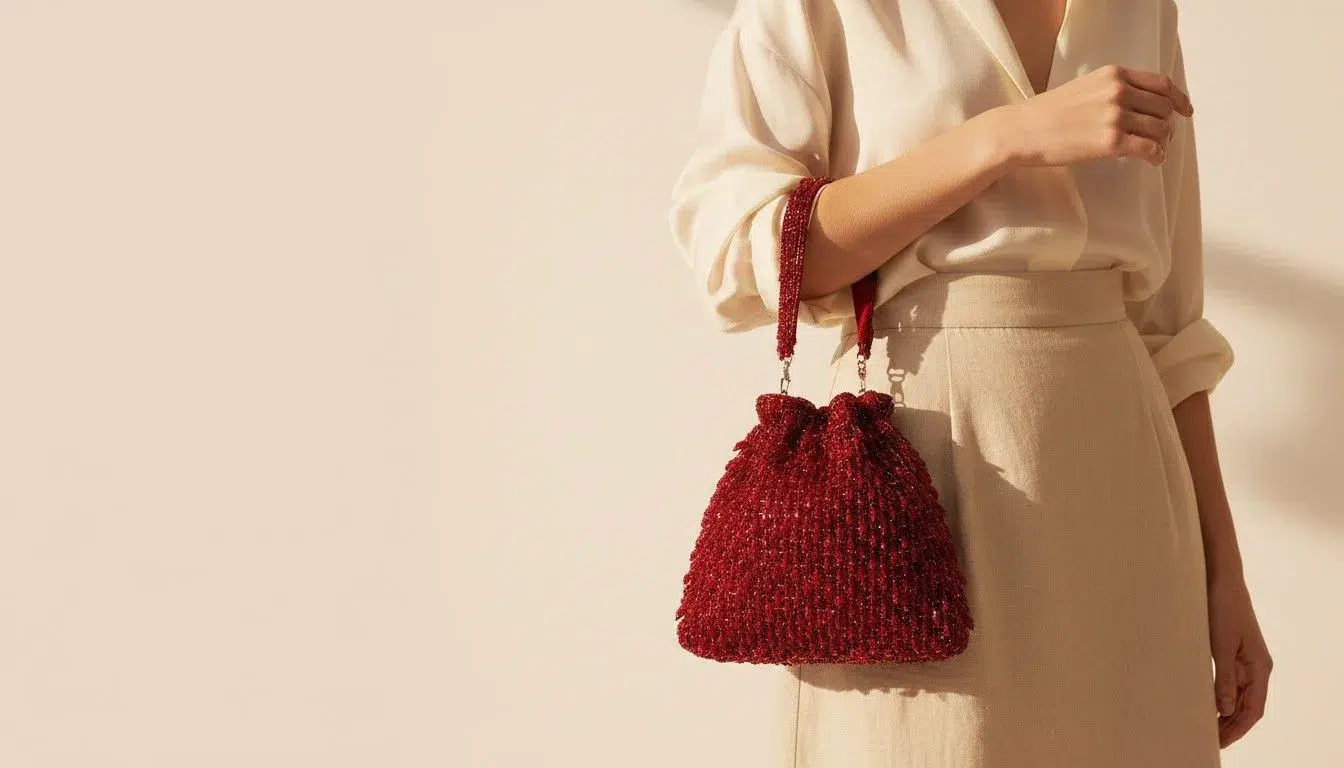
The first thing I noticed wasn't the colour. It was the weight. The moment I slipped the braided wrist cord over my hand at a Diwali puja last year, the bag settled against my hip with a density that cheap potlis simply don't have — all those embroidered threads adding up to something that feels genuinely crafted. I've now carried this velvet potli clutch by The Tan Clan through a full year of family dinners, small pujas, and one memorably chaotic cousin's mehendi, and I paid for it with my own money during a Myntra Diwali sale. I own the red embroidered variant — dense geometric embroidery over a velvet base — and it has become the one festive accessory I reach for when I need both hands free and still want to look like I made an effort. This review is everything I have learnt, including the parts I wish I had known before buying.
Quick Verdict
A beautifully constructed ethnic wristlet that solves the hands-free festive problem — as long as you go in knowing its real capacity limits.
The Short Answer
The Tan Clan velvet potli clutch is a dense, handcrafted festive wristlet with geometric zari embroidery over a velvet base, a thick braided wrist cord, and a drawstring closure. It fits a slim phone, keys, and a lipstick — nothing more. The embroidery has held its form through a year of regular use; the drawstring has not loosened with time but remains stiff and requires two hands to close properly.
Disclosure: This post contains an affiliate link. I bought this potli with my own money. If you purchase through my link, I may earn a small commission at no extra cost to you. All opinions are entirely my own. — Soumya
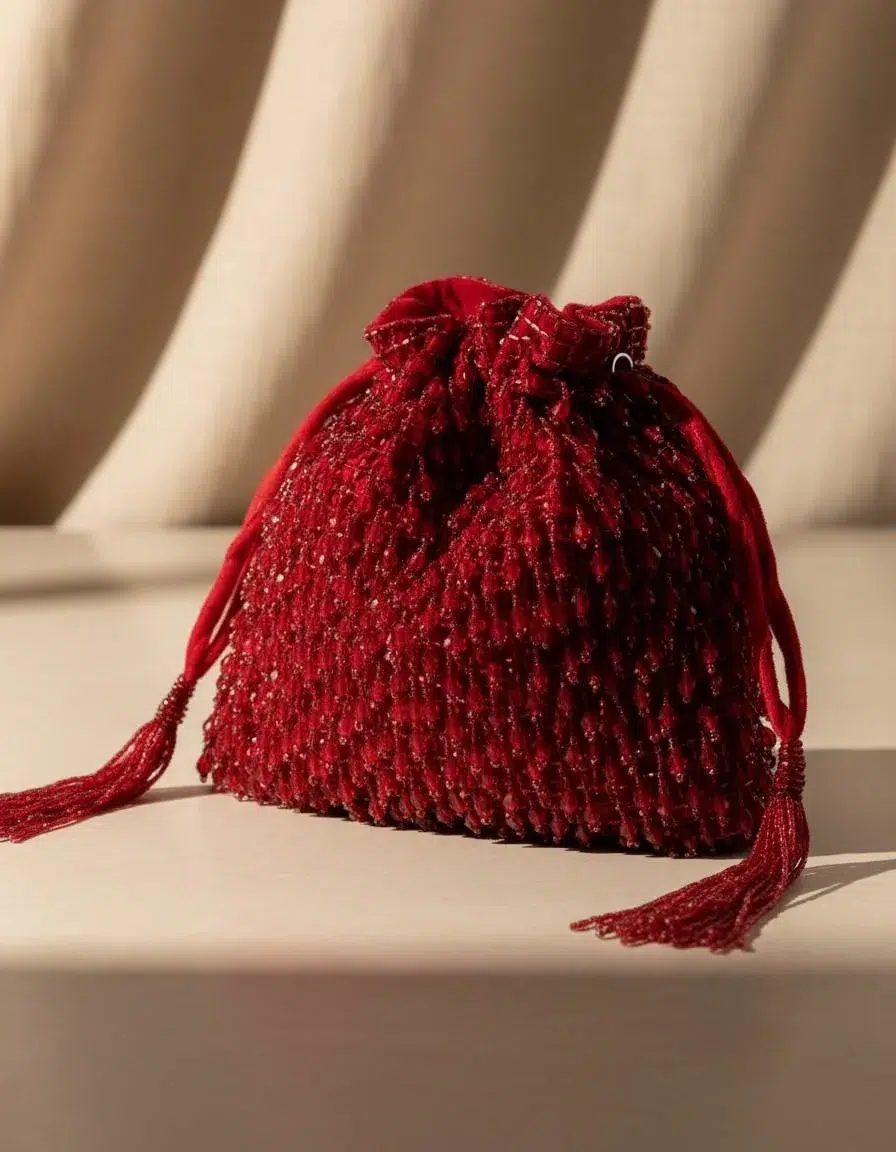
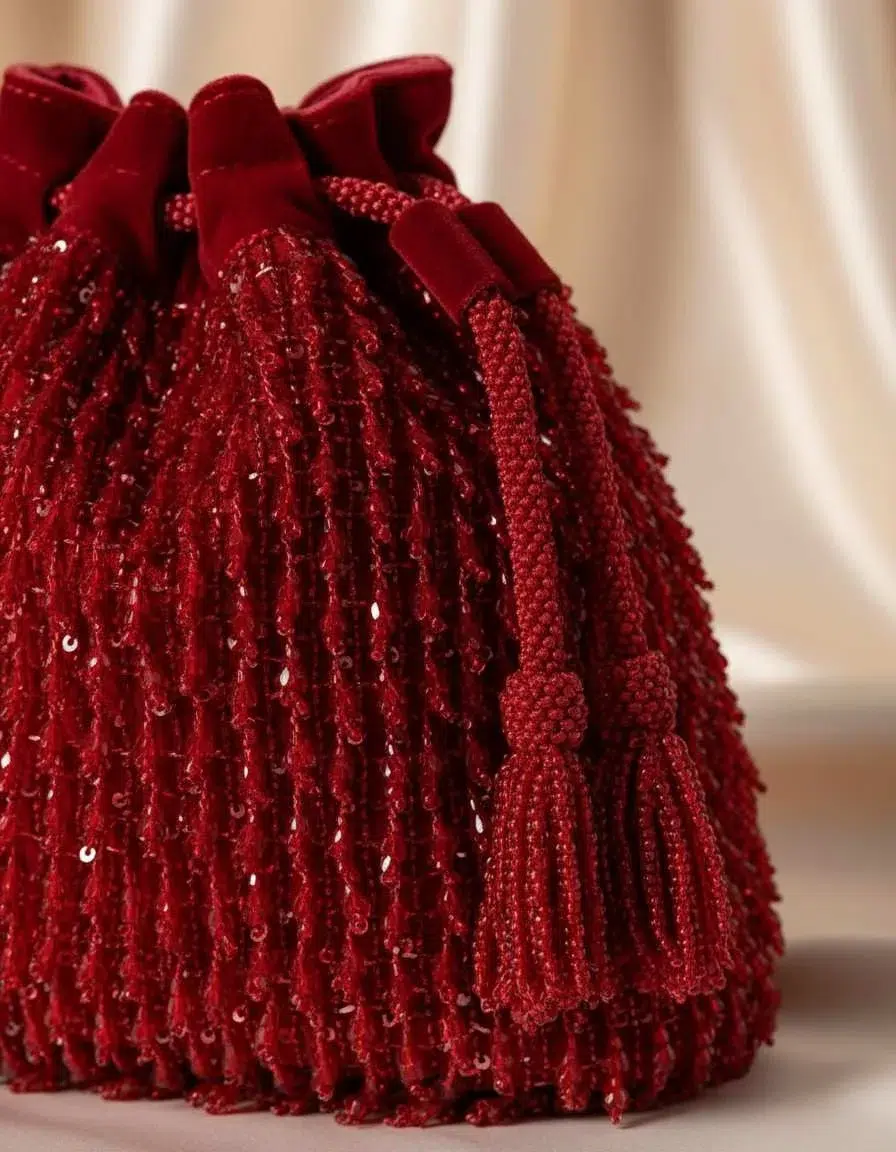
This velvet potli clutch is not a soft pouch. Pick it up and you immediately feel the difference — the embroidery adds a physical layer of density across the entire surface, so the bag holds its rounded dome shape even when empty. The velvet base is plush to the touch on the reverse side of every embroidered column, but the outer face is almost entirely covered in geometric zari threadwork, which means it doesn't snag on silk the way loose-pile velvet does. That single construction detail matters enormously at a wedding reception.
| Specification | Detail |
|---|---|
| Material | Velvet base with dense zari thread embroidery |
| Dimensions | 16 cm height × 21 cm width × 4 cm depth |
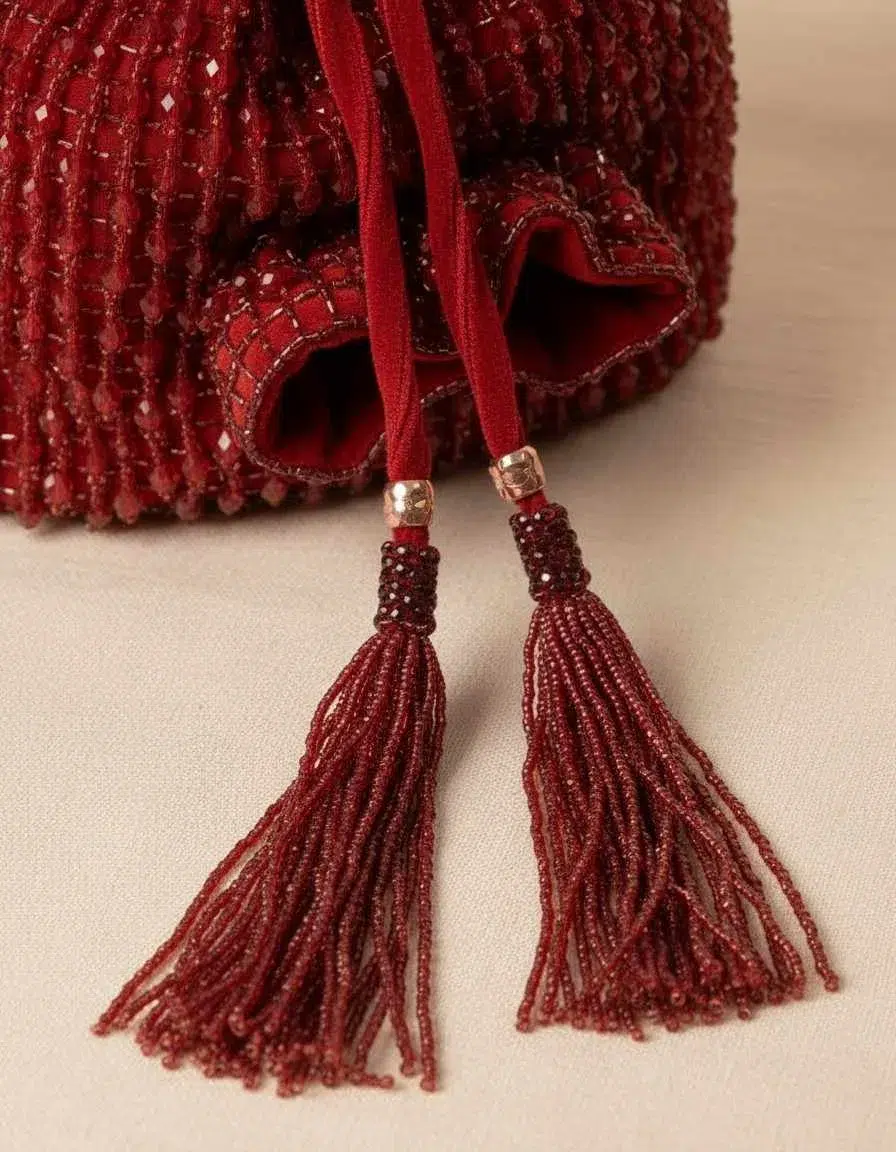
| Closure | Drawstring with beaded braided cord and tassel pulls |
| Strap / Handle | Thick braided wrist loop — same cord as the drawstring |
| Compartments | 1 main compartment, no internal pockets |
| Water Resistance | None — wipe only with a dry cloth |
| Price | ₹3,750 on Myntra |
At ₹3,750 this sits above mass-market potlis (₹500–800 on Amazon) and below boutique designer versions that cross ₹6,000. Think of it as the middle tier: you get embroidery density and structural integrity that cheap potlis cannot match, without paying the premium of a Pernia's Pop-Up Shop designer label. For that specific slot — durable, good-looking, actually functional at a puja — the price is justified. If you only need a potli for a single wedding, a ₹900 alternative does the job. If you will carry it through a full festive season year after year, the construction quality here holds up in a way a cheaper bag won't.
"Out of the box, the velvet base felt plush, and the zari embroidery had a surprising physical weight to it. It doesn't feel scratchy against the skin — you can feel the heavy texture of the metallic threads, but it holds."
The one design detail that genuinely separates The Tan Clan from competitors at this price point is the wrist cord construction. Standard potli bags use a thin silky rope that bites into the wrist once the bag carries any real weight. Here, the braided cord is substantially thicker — closer to the width of a shoelace than a thread — which distributes the load across a wider surface of skin. Load it with a phone, keys, and a brass lipstick tube and the cord still feels comfortable after four hours. That is not a marketing claim; it is an ergonomic reality that most brands overlook entirely. As Harper's Bazaar India notes in its feature on the rise of Indian designer bags, handcrafted Indian accessories are increasingly being judged on functional detail — not just visual embellishment.
One honest caveat: the 21 cm width photographs generously. Because the velvet and embroidery have zero stretch, the actual usable interior volume is considerably smaller than the flat dimensions suggest. The fabric does not give — it holds its shape rigidly. That is its strength structurally, and its limit practically.
The braided cord sits across the wrist bone differently than a thin silky rope does. You feel its presence — a slight warmth from the dense threading — but after the first few minutes it settles and stops registering entirely. That is the best thing I can say about a wrist accessory you will carry for four hours straight while also managing a toddler, greeting relatives, and balancing a plate of laddoos.
I slip this onto my wrist the moment I step out of the car at any venue. The thick cord means both hands stay genuinely free — I can hold my son, accept a glass of nimbu paani, and still reach into the bag without putting it down. A structured metallic clutch makes that impossible. A thin-corded potli makes it painful. This sits in the narrow band between those two options and earns its keep there specifically.
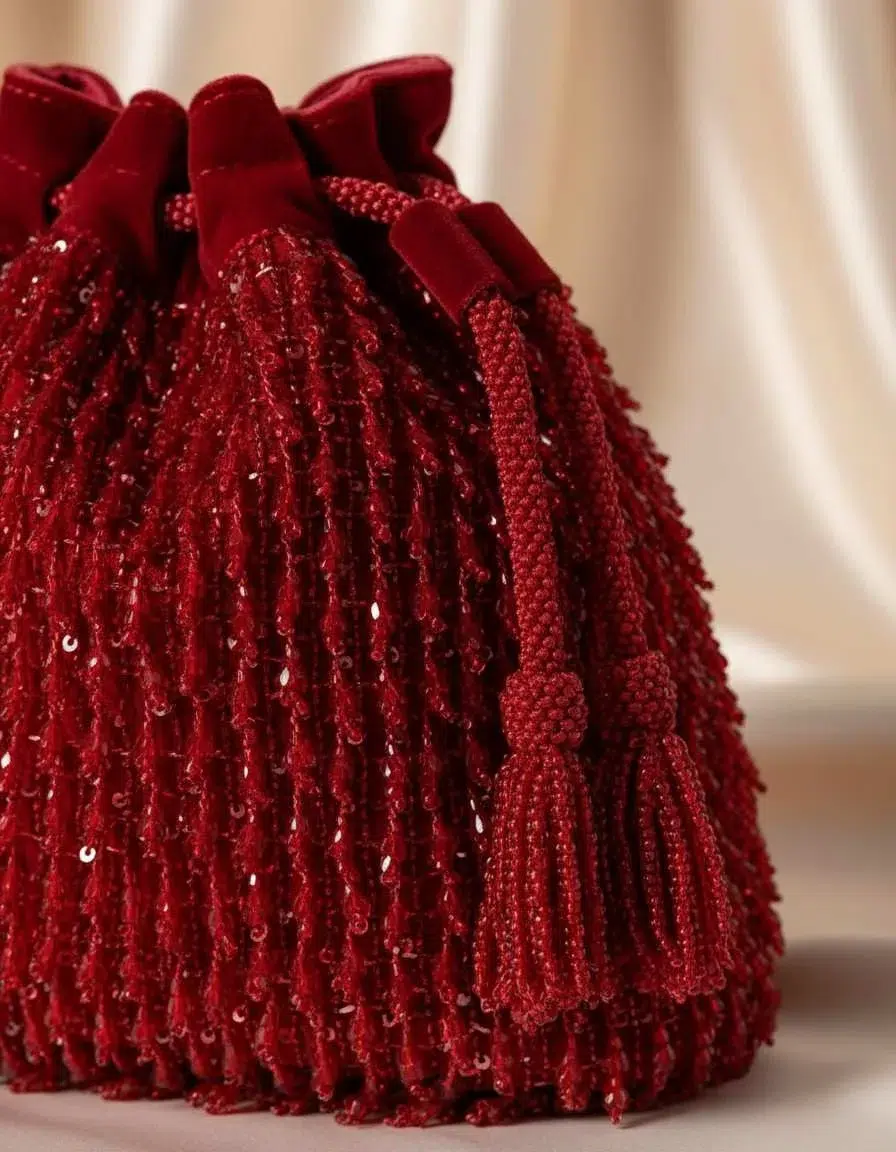
Most people assume a heavily embroidered potli needs an equally embellished outfit to carry it off. That assumption is wrong for this specific bag. The geometric, dense pattern reads as a texture rather than a print — which means it anchors plain, single-colour outfits far better than busy lehengas where it simply disappears into the noise. My most-worn combination is this bag against a deep jewel-toned silk saree or a plain velvet blouse and skirt. The embroidery does the talking; the outfit doesn't need to.
For Indian occasions specifically: I wore this through a four-hour Diwali puja where the lighting shifted from late afternoon sunlight to diyas, and the zari caught the flame light in a way that made it look like it cost significantly more than it did. At a cousin's mehendi the following month, paired with a plain emerald kurta set, three separate people asked where I had bought the bag. Nobody asked about my outfit.
Wears well with
Cord comfortable throughout. Bag set down on a carpeted floor three times — no visible marks on the velvet or embroidery.
Grabbed repeatedly by sticky hands at close range. No threads pulled, no embellishments loosened. The density of the work actually protects it.
No snagging. The embroidery surface is smooth enough that it slides past silk without catching — a genuine daily-use relief.
Opening and closing requires two hands every time. If you need to retrieve your phone quickly, you will need to put the bag down first.
The one honest frustration that persists even after a year of use: the drawstring channel has not loosened with time the way a well-worn cord usually does. Most bags break in with use. This one has not. The inner hem needs a satin or silk lining to let the cord pull smoothly — without it, cinching the bag closed is a two-handed, forceful operation every single time. That is a design oversight that a small construction change would fix entirely.
If you are pairing this with a matte oxidised earring rather than a polished one, the tonal connection works particularly well — both the embroidery and an oxidised finish share that quality of absorbing light rather than throwing it back. The combined effect reads considered rather than matched.
Yes — but for a specific kind of buyer. If you need a hands-free festive wristlet that looks considered, holds its construction through years of regular use, and works across the full range of intimate Indian occasions, this earns its price. If you need a hard-shell statement clutch for formal wedding receptions, or a bag that fits more than a phone, keys, and one card, look elsewhere.
The single most important thing to understand before buying: the interior is meaningfully smaller than the listed 21 cm width implies. The embroidery and velvet have no stretch. A large iPhone Pro Max in a thick case requires a forceful squeeze through the cinched opening — and then you still have to close the stiff drawstring with both hands around it. That is not a dealbreaker for what this bag is designed to do. But it will frustrate anyone who expects the volume its silhouette suggests.
Wears beautifully when
Worth considering if
Realistically: one slim smartphone (iPhone 15 or similar without a bulky case), a car key fob, a lipstick or lip gloss, and one folded currency note. That is the practical upper limit. A compact mirror pushes it. A power bank, sunglasses, or any second card make the bag impossible to close cleanly. The listed 4 cm depth is accurate and unforgiving — what reads as a roomy silhouette in photographs is a structured, shape-holding bag that does not expand to accommodate ambition.
This is for you if
Maybe skip it if
Durability Over Time
Month 1
Drawstring stiff from new. Velvet plush and fully saturated in colour.
Month 6
Drawstring still stiff — no break-in. Slight friction wear on the velvet at the base edges from being set down.
Year 1
Zari embroidery entirely intact — no tarnish, no unravelling. Base edge wear still minor. Would buy again.
| Feature | The Tan Clan (₹3,750) | AMYRA Velvet Potli (~₹3,500) | FabIndia Block-Print (~₹1,500) |
|---|---|---|---|
| Embroidery Density | Dense geometric zari — holds shape | Floral zari — similarly dense | Block print, no embroidery |
| Drawstring Channel | Stiff — two hands required | Satin-lined — smoother pull | Easy single-hand pull |
| Wrist Cord | Thick braided — very comfortable | Standard rope — thinner | Thin cord — digs in |
| Festive Occasion Fit | Pujas, intimate gatherings, mehendi | Similar occasions | Casual daytime only |
| Durability (reported) | 1 year confirmed — zari intact | Not personally tested | Cotton — prone to fraying |
The AMYRA comparison is worth noting honestly: its satin-lined drawstring channel is the design fix this bag needs. If The Tan Clan ever updates the inner construction, it would remove the single biggest friction point from an otherwise well-made product. Until then, the thicker wrist cord remains The Tan Clan's decisive ergonomic advantage over competitors at similar prices.
If you want to see how this bag works inside a complete festive look, the Uptownie linen co-ord review covers an outfit pairing that bridges the smart-casual and festive registers — useful context if you are building a capsule around Indian occasion wear.
The instinct with a dense, embroidered bag is to match it to an equally embellished outfit. That is the wrong move with this one. The geometric zari pattern is dense enough to read as a solid texture from three feet away — and that is exactly its styling strength. It behaves more like a structured accessory than a decorative one, which means it anchors plain outfits with real authority and simply vanishes into busy lehengas where it has no room to register.
The contrast principle is what I keep coming back to after a year of wearing it. A deep emerald silk kurta set with minimal jewellery, this bag on the wrist, and nothing else competing for attention — that combination consistently draws more comment than any heavily accessorised look I have built around it. The bag does the work. Let it.
A plain Banarasi silk saree in ivory or deep wine — the bag adds the only embellishment the look needs, and the zari tones pull from both the gold woven into Banarasi borders and the deeper body colour. A crisp linen kurta set for a daytime puja — the texture contrast between raw linen and the dense velvet embroidery is the kind of detail that looks deliberate and considered without requiring any effort. An office kurta set carried into an evening function directly from work — the bag shifts the register of the outfit from daytime professional to festive-evening in a single swap. And a plain velvet blouse with a silk skirt, where matching the velvet base of the bag to the blouse fabric creates a tonal echo that looks expensive.
Outfit Pairings — Indian Context
The Equation
One combination I have not made work: a heavily embellished festive lehenga where the dupatta itself is embroidered. The bag gets lost completely — the eye has nowhere to rest, and the potli neither adds to nor subtracts from the look. Save it for the occasions where restraint is the actual statement, not the fallback.
"Knowing what I know now about the stiff drawstring and the limited capacity — if I left this at a venue today, I would immediately add it back to my cart."
Worth noting: the drawstring has not loosened in a year of use. If you need quick one-handed access to your phone, this will test your patience every time.
Rating rationale: 4/5 for a hands-free festive wristlet that genuinely holds up in construction and comfort. One point withheld for a stiff drawstring channel that a simple satin lining would have fixed.
The Tan Clan velvet potli clutch is available on Myntra at ₹3,750. That positions it above the ₹500–800 mass-market tier and well below the ₹6,000-plus boutique category — a price that reflects real construction quality without asking you to treat it as an investment piece. It is available in multiple colourways; the red embroidered variant reviewed here has been the most durable in my experience, because the dense embroidery actively hides the minor friction wear that accumulates on any bag you carry regularly to the floor.
One comparison worth making honestly: the AMYRA black velvet potli at a similar price point has a satin-lined drawstring channel that pulls with one hand. If the two-handed closure is a dealbreaker for you, that is the bag to consider instead. If the thick wrist cord is your priority — which it should be for four-hour events — The Tan Clan's ergonomic advantage holds.
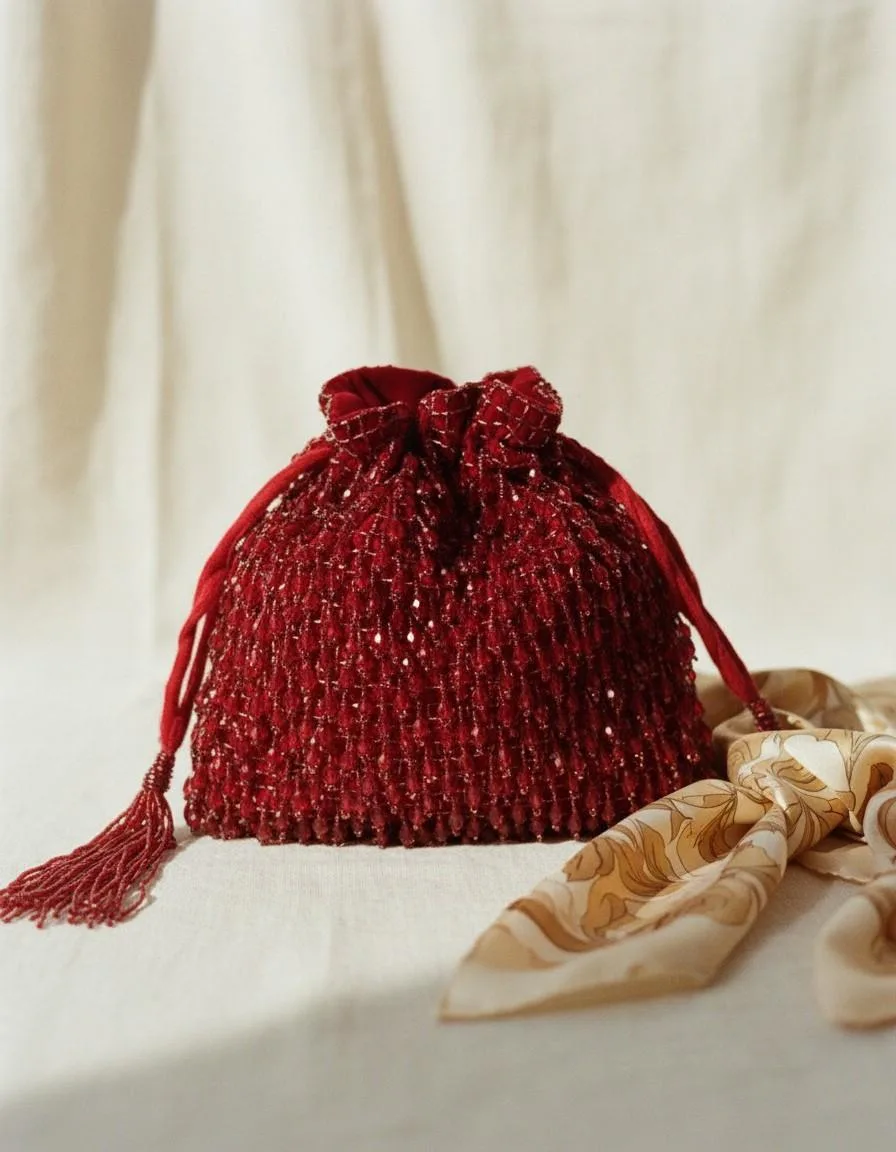
The Tan Clan Embroidered Potli Clutch
₹3,750 on Myntra · Multiple colourways available
Check Price on MyntraAffiliate link — I earn a small commission if you buy through this link, at no extra cost to you. I bought this bag with my own money and have carried it for over a year. — Soumya Smruti Sahoo
Yes, because the construction quality — dense zari embroidery, thick wrist cord, and a velvet base that holds its shape — genuinely outlasts cheaper alternatives in the ₹500–800 range. At ₹3,750 you are paying for a bag that survives a full festive season year after year, not a single-occasion piece. The one caveat is the stiff drawstring channel, which a satin lining would fix at minimal cost — but that limitation does not undermine the overall durability case.
Realistically: one slim smartphone, a car key fob, and a single lip product. The listed 21 cm width photographs generously, but the velvet and embroidery have zero stretch — the actual usable interior is meaningfully smaller than the flat dimensions suggest. A large iPhone Pro Max in a thick case is a tight, effortful squeeze through the cinched opening. A power bank, compact mirror, or sunglasses will not fit alongside anything else.
Plain, solid-toned outfits work best — a plain silk saree, a single-colour kurta set, or a velvet blouse with a silk skirt. The geometric embroidery reads as a texture rather than a pattern, which means it anchors minimal outfits with real authority. Avoid pairing it with heavily embroidered lehengas or busy printed dupattas, where the bag disappears into the visual noise entirely and the contrast logic that makes it work breaks down.
No, based on one year of active festive use — the zari embroidery on this bag has not tarnished or unravelled at any point. The density of the threadwork is actually protective: because the threads are packed tightly and run in uniform columns, there are no loose ends to catch and pull. Minor velvet friction wear appeared on the base edges after several months of being set down on carpeted floors, but the embroidered surface itself remains fully intact.