


The brass rollerball was the first casualty. I had owned this PamperBug daily gratitude journal India for exactly three days before I realised my favourite pen and its 80 GSM paper were fundamentally incompatible — ink ghosting straight through, every word bleeding onto the back of the previous page. I switched to a ballpoint. The habit stuck anyway. I have been using this journal four days a week since late January, and it sits on my office desk right now, cover slightly dog-eared at the bottom corner, doing its job. I am a founder who builds brand identities around clean type and high-contrast layouts. I usually despise the gratitude journal market — the floral clutter, the cursive excess, the live-laugh-love energy. This one I kept using. That is the whole review, really. But since you are here, let me tell you exactly why.
The PamperBug Daily Gratitude Journal is the best daily gratitude journal India has at this price point for one specific person: the time-poor professional who needs structured prompts, a lay-flat wiro binding, and absolutely zero fuss at 6 AM. At under ₹300, it is not competing with the Five Minute Journal on paper quality — and it should not try to. What it does is remove every possible excuse not to write.
Affiliate link — I earn a small commission at no extra cost to you. I bought this journal with my own money.
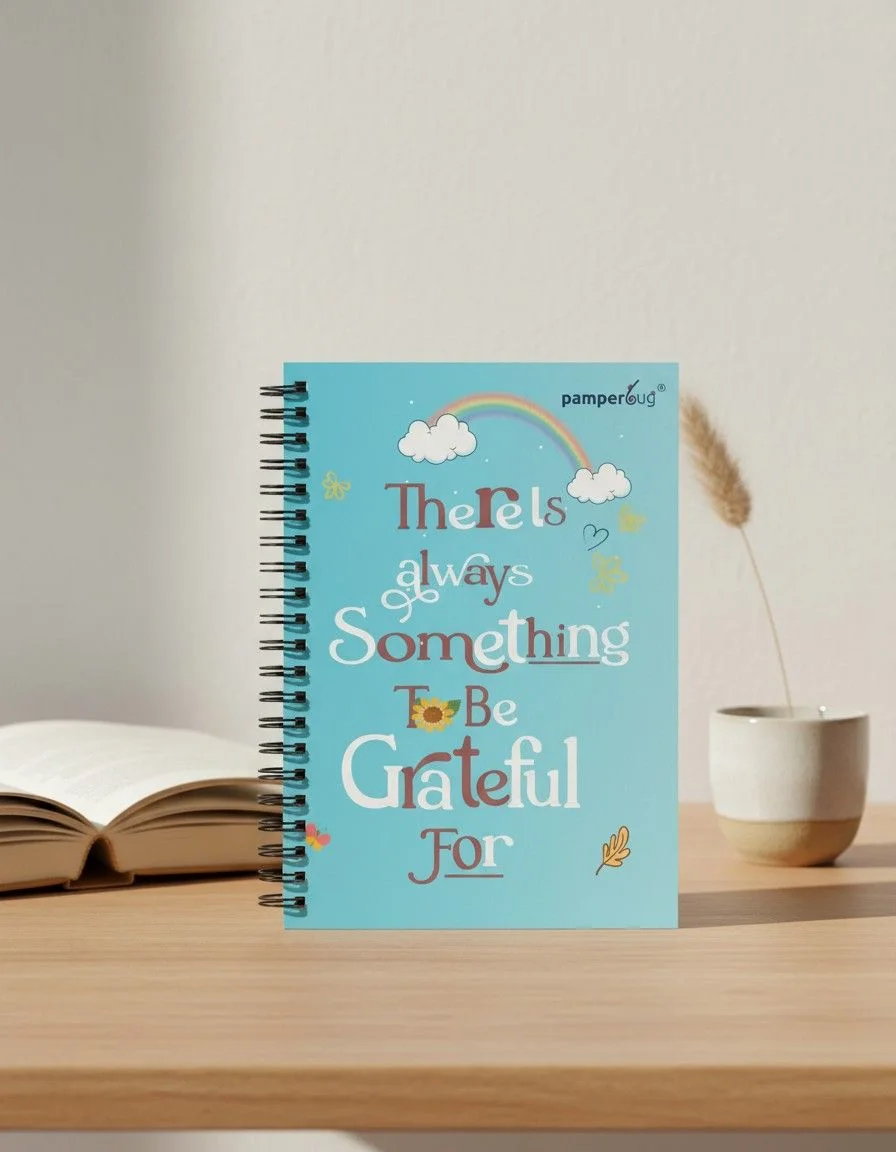
The PamperBug daily gratitude journal India arrives looking exactly as functional as it is. No gift-ready packaging, no tissue paper, no ribbon. The teal cover — screen-printed with a mix of cloud and rainbow graphics and the phrase "There is always something to be grateful for" in mismatched fonts — is the visual equivalent of a motivational poster your well-meaning colleague pins above the office printer. It is cheerful. It is not minimal. If you have a monochromatic desk, this cover will be the loudest thing on it.
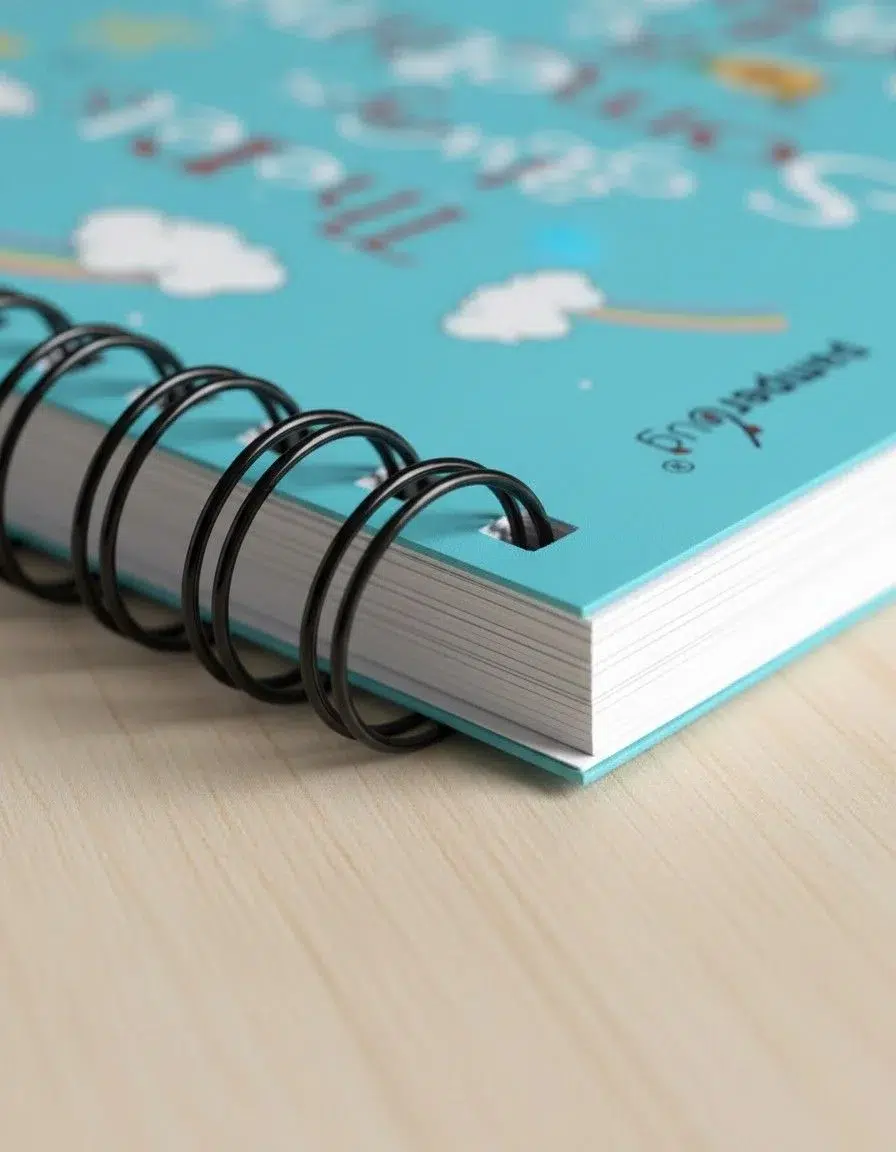
Set the cover aside. The binding is what you actually paid for. The black wiro coil runs the full length of the spine and is substantial — not the thin silver coil that warps after a fortnight of daily use. This one held its shape through four months of desk use without a single loop pulling loose. More importantly, the journal folds completely flat back on itself: you can fold the back cover underneath, leaving a half-A5 footprint on a crowded desk. Premium case-bound journals like the Moleskine cannot do this. They require one hand to hold the pages flat while the other writes. Here, both hands are free.
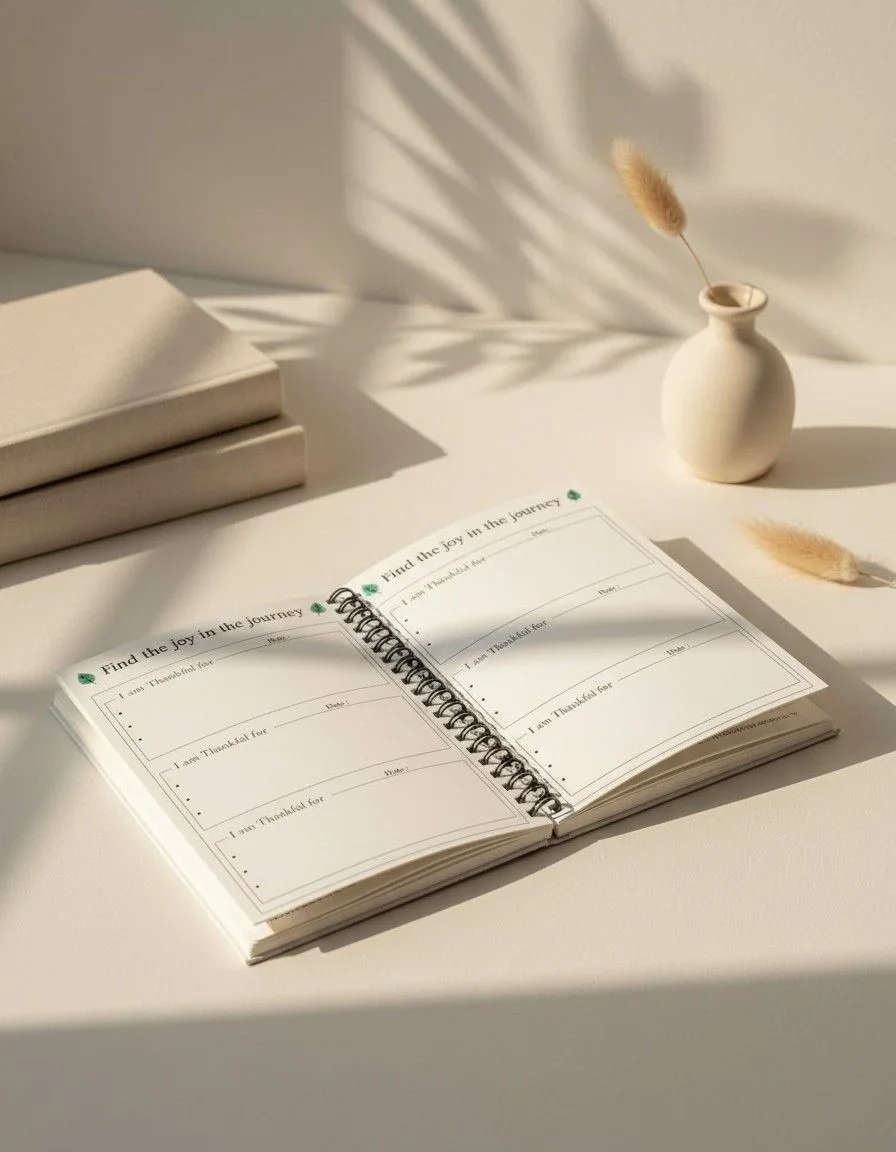
The interior layout is spare to the point of austerity, which is exactly right. Each spread contains the header "Find the joy in the journey" and several dated "I am Thankful for" prompt boxes — three bullet lines each, no more. There are no affirmation spaces, no evening reflection sections, no weekly habit trackers. You write three things. You close the book. That is the entire interaction. For someone whose mornings are compressed to fifteen minutes before a one-year-old wakes up and immediately needs something, this zero-friction format is not a limitation. It is the feature.
Smooth — genuinely smooth. The surface takes a standard ballpoint pen cleanly, with no drag or fibre-catching. Run your palm across a blank page and it feels like slightly heavier copy paper. What it does not feel like is the 100 GSM cream stock you find in the Brightside Journal or the Lauret Blanc range. Under a desk lamp, hold a written page up to the light and you will see your words ghost through. Use a thick gel ink or a brass rollerball and that ghost becomes a full bleed, rendering the reverse side unusable. This is the single most important thing to know before buying: this journal requires a dry ballpoint or a pencil. It will not forgive anything wetter. According to wellness author Vasudha Rai, journaling is fundamentally about releasing energy onto the page — and with the right pen here, that release is frictionless.
| Specification | Detail | Real-world meaning |
|---|---|---|
| Size | A5 (148 × 210mm) | Fits a standard desk drawer; does not dominate a small work surface |
| Pages | 120 pages | At four days a week, roughly eight months of journaling |
| Paper weight | 80 GSM | Ballpoint and pencil only — gel and rollerball inks bleed through |
| Binding | Wiro (metal coil) | Folds completely flat; lies open without hand pressure |
| Cover | Soft printed card | Lightweight; corners dog-ear after a few months of desk use |
| Prompt format | Undated "I am Thankful for" + 3 bullet lines | Start any day of the year; no guilt for missed entries |
| Care | Keep flat on desk; avoid bag carry | Wiro loops will warp inside a packed tote within weeks |
"I push my heavy brass pen aside every morning now. The journal won. The pen lost."
Mine lives on my office desk. Specifically: pushed to the left of my laptop, spine facing me, so I see it before I open a browser. That placement was deliberate — the journal needed to be the first thing my hand reached for, not the second. It has not moved in four months. The surface beneath it is wood-grain laminate, which means the soft cover does not slip. Put it on glass and it will drift every time you fold it back.
The weight is worth saying plainly: this journal is light enough that picking it up feels like nothing. That matters more than it sounds. A heavy, hardbound journal carries a subtle pressure — it signals that what you write inside should be proportionally significant. This one does not. It is the stationery equivalent of a ballpoint you keep by the phone: low-stakes, always available, never precious. That quality is what lets you fill in three lines on a morning when your toddler has already pulled every book off the shelf before 6 AM and you have exactly ninety seconds before the crying starts again.
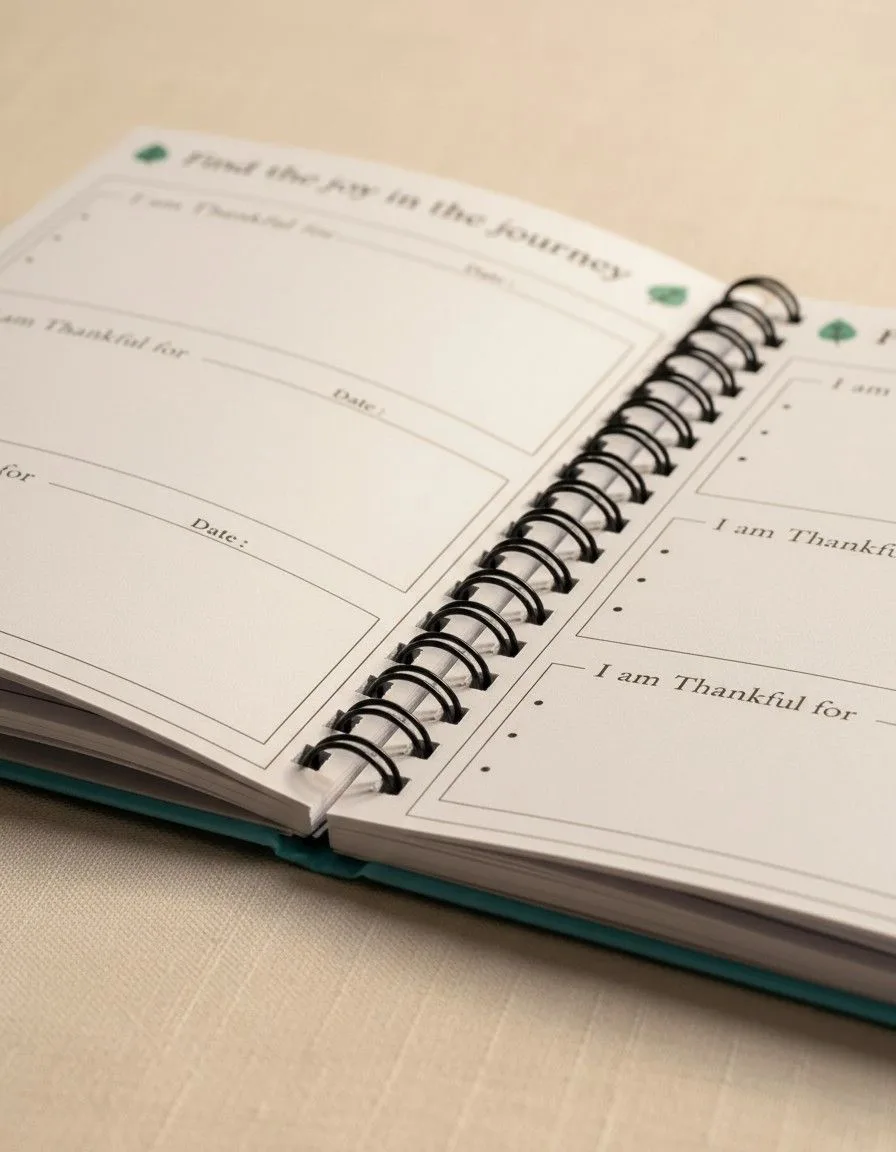
Here is the assumption this product category gets wrong: that a journal is something you carry. Most gratitude journals are marketed as portable companions — toss them in your bag, write on your commute, use them anywhere. The PamperBug, specifically, should not leave a fixed surface. The wiro binding is sturdy on a desk. Inside a packed laptop bag or a heavy leather tote — the kind that also holds a charger, a lunchbox, and a toddler's snack — those metal loops will get crushed and warped within a fortnight. I tested this once, slipping the journal into my work bag for a day trip to a client meeting in Bhubaneswar. The bottom two loops bent inward. They still work, but the pages catch slightly now when you fold it back. It is a desk journal. Treat it as one.
The 80 GSM paper held up fine through Odisha's humid pre-monsoon weeks — no warping, no page-sticking, no cockling at the edges the way thinner paper sometimes does near a window. If your desk is in a non-AC room and you journal with the window open in May, the pages stay flat. That is genuinely reassuring for a journal at this price. For a wider soft living context and more ideas on building a calmer desk ritual, the KapdeWali Living Style archive has more on intentional home setups.
It built the habit. That is the only claim it needs to make, and it makes it honestly. I came to this journal having already abandoned a Moleskine Classic (too blank, triggered my perfectionism), talked myself out of the Intelligent Change Five Minute Journal (beautiful object, hard to justify ₹3,500 for a daily scratchpad), and spent three weeks writing on random loose sheets that I immediately lost. The PamperBug cost under ₹300, arrived in two days, and removed every decision from my morning. I have used it four days a week for four months. No other journal I have tried has lasted beyond three weeks.
But here is the thing about a journal that works: it reveals what you actually needed, which is sometimes different from what the journal provides. Four months in, I know I want slightly thicker paper. I know I want the prompts to evolve — the repeated "I am Thankful for" boxes work beautifully at week one and feel slightly mechanical by month four. If I spilled coffee on this journal today, I would look for the next version up before automatically reordering. That is an honest verdict. It is not a failure. It is a beginning.
Yes — badly, and with no ambiguity. A Uniball gel ink pen leaves visible ghosting on the reverse of every page. A thick brass rollerball bleeds completely through, making the back of the page unusable. A standard Reynolds or Cello ballpoint produces clean, sharp lines with zero show-through. A pencil works perfectly. This is not a manufacturing defect; 80 GSM is simply the paper weight at which gel and rollerball inks will almost always bleed. The marketing does not mention this, which is why I am. If your everyday pen is a gel ink — Pilot G2, Uniball Signo, anything with a liquid ink cartridge — budget for buying a dedicated ballpoint before you budget for the journal itself.

| Journal | Price (approx.) | Paper | Binding | Best for |
|---|---|---|---|---|
| PamperBug Daily Gratitude | Under ₹300 | 80 GSM — ballpoint only | Wiro — lays flat | Habit-building, desk use, zero-friction mornings |
| Lauret Blanc Daily Planner A5 | ₹400–500 | 80–90 GSM — slightly better | Perfect-bound — does not lay flat | Planning + gratitude hybrid; needs one hand to hold open |
| Five Minute Journal (Intelligent Change) | ₹3,500+ | 90 GSM — fountain pen safe | Case-bound — does not lay flat | Archival journaling; morning + evening format; pen snobs welcome |
On price: at under ₹300, this journal sits comfortably below a weekend brunch bill and above a standard A5 ruled notebook. It costs less than the ballpoint pens you should use with it. That anchoring matters — it is cheap enough to use without ceremony, expensive enough to feel intentional. That gap is exactly where habit-formation lives.
The teal cover is genuinely cheerful. That is not a criticism — it is a design choice that works differently from how you might expect. On a desk that already has brass hardware, matte black notebooks, and dark wood, the PamperBug's sky-blue cover does not blend. It pops. And that visibility is functional: you see it before you see your laptop. It becomes a visual cue before it is anything else. I stopped trying to hide it behind other things within the first week.
The journal sits best when it is not styled at all — just left open at the current page, folded back on itself, taking up half the space of an A5 sheet. That flat-open position is its natural state and, coincidentally, its best-looking one. The white pages against a wood desk read clean. The wiro spine catches light in a way the soft cover does not. If you want to make it look considered rather than casual, the only thing that actually helps is a single good ballpoint pen laid across the open page. Not a pen holder. Not a tray. Just the pen. Done.
The honest answer depends entirely on one variable: what pen you use every day. If your answer is a ballpoint — Reynolds, Cello, Pilot BPS, anything with a dry oil-based ink — this is the best daily gratitude journal India has at this price. Nothing else at under ₹500 offers the lay-flat wiro binding, the undated format, and the structured three-prompt layout in the same package. If your answer is a gel ink or a fountain pen, this journal will frustrate you inside a week regardless of how well it fits every other criterion. Upgrade to the Lauret Blanc at ₹400–500 for modestly better paper, accepting that it will not lay flat. Or save for the Five Minute Journal if you want the format to grow with you and the paper quality to reward a good pen. The PamperBug earns its place precisely because it refuses to be anything other than what it is: a daily gratitude journal for busy mornings, printed on functional paper, bound in a way that removes every last excuse not to open it.
PamperBug gratitude journal + a ballpoint pen + a fixed spot on your desk = the only morning ritual that costs less than your morning chai and asks less of you than your inbox.
The brass rollerball lives in a drawer now. The PamperBug sits open on my desk, current page folded back, a Cello ballpoint clipped to the wiro coil. That is not the morning ritual I imagined when I ordered it — I imagined a beautiful pen, slow handwriting, the whole considered thing. What I got instead was three lines before the baby woke up, four days a week, for four months. Unglamorous. Consistent. The only morning practice I have ever maintained past February.
If you want a journal that doubles as a beautiful desk object, look elsewhere. If you want one that makes you actually write — that removes the blank-page anxiety, the pen-holding pressure, the perfectionism that kills most journaling habits before they set — this is the one. Buy the cheapest ballpoint you own. Put the journal on your desk tonight. Write three things tomorrow morning before you open your phone. That is the whole practice. It works.
Affiliate link — Soumya Smruti Sahoo earns a small commission at no extra cost to you.